



The Zone vs. the Self - Who Really Plays the Music?
People often talk about getting into "the zone." But what exactly is "the zone," and how does one get into it?
The Zone vs. the Self - Who Really Plays the Music?
This post is part of my series, Where Music Comes From, an exploration of the mysterious, mystical, spiritual, and transcendent origins of the art form we call music.
Chances are you have heard of "the zone." Athletes talk about it, musicians talk about it, computer programmers talk about it, accountants talk about it. People from all walks and disciplines experience it. You too have likely found yourself in the zone—or flow state—at some point in your life. But what is the zone, or flow state?
According to Psychology Today, flow state was first discovered and documented by psychologist Mihaly Csikszentmihalyi. Csikszentmihalyi spent decades studying flow state and identified nine components that tend to be present when someone enters it:
- Challenge-skill balance
- Merging of action and awareness
- Clarity of goals
- Immediate and unambiguous feedback
- Concentration on the task at hand
- Paradox of control
- Transformation of time
- Loss of self-consciousness
In this post, I will give you my perspective of what it's like being in the zone and ways I've found to achieve it. Specifically, I'll talk about:
- What exactly is the zone?
- What is my mind thinking or doing as I play in flow state?
- Who is the "me" that plays or composes music in the zone?
- How does "God" fit into music and flow state?
The Zone Defined
I have seen several definitions of the zone and flow state, but to give you a more personalized understanding of it, I want to provide my own definition of it. For my purposes, I use the terms "zone" and "flow state" synonymously.
For me, flow is a state of extreme productivity arising from a combination of refined skills, pure joy, and a relaxed but attentive mind. It is a state of consciousness that lies somewhere between being fully conscious and fully unconscious. The zone is a place of extraordinary awareness in which peak creativity and performance occurs.
I think the best example to use that most people will relate to is driving. If you think back to the days when you were learning to drive, every experience behind the wheel was anything but flow state. I remember feeling like there were too many things to think about - the mirrors, the gear shift, the brake, the accelerator, the blinkers, the windshield wipers, the A/C or heat, the radio, etc. When I was learning to drive, I had to constantly think consciously about every little thing I did behind the wheel.
Over time, however, that laborious effort gradually gave way to subconscious acting. Now when I drive, I don't have to consciously think about all those things. My subconscious controls most of my actions when I am behind the wheel of a car. As a result, there are times—when traffic conditions are easy, when the weather is nice, when I'm not in a hurry, etc.—when I achieve flow state while driving. I have the necessary skills. When conditions are just right, it can be a joy. And I get in that relaxed but attentive mental state.
What Is My Mind Thinking As I Play in the Zone?
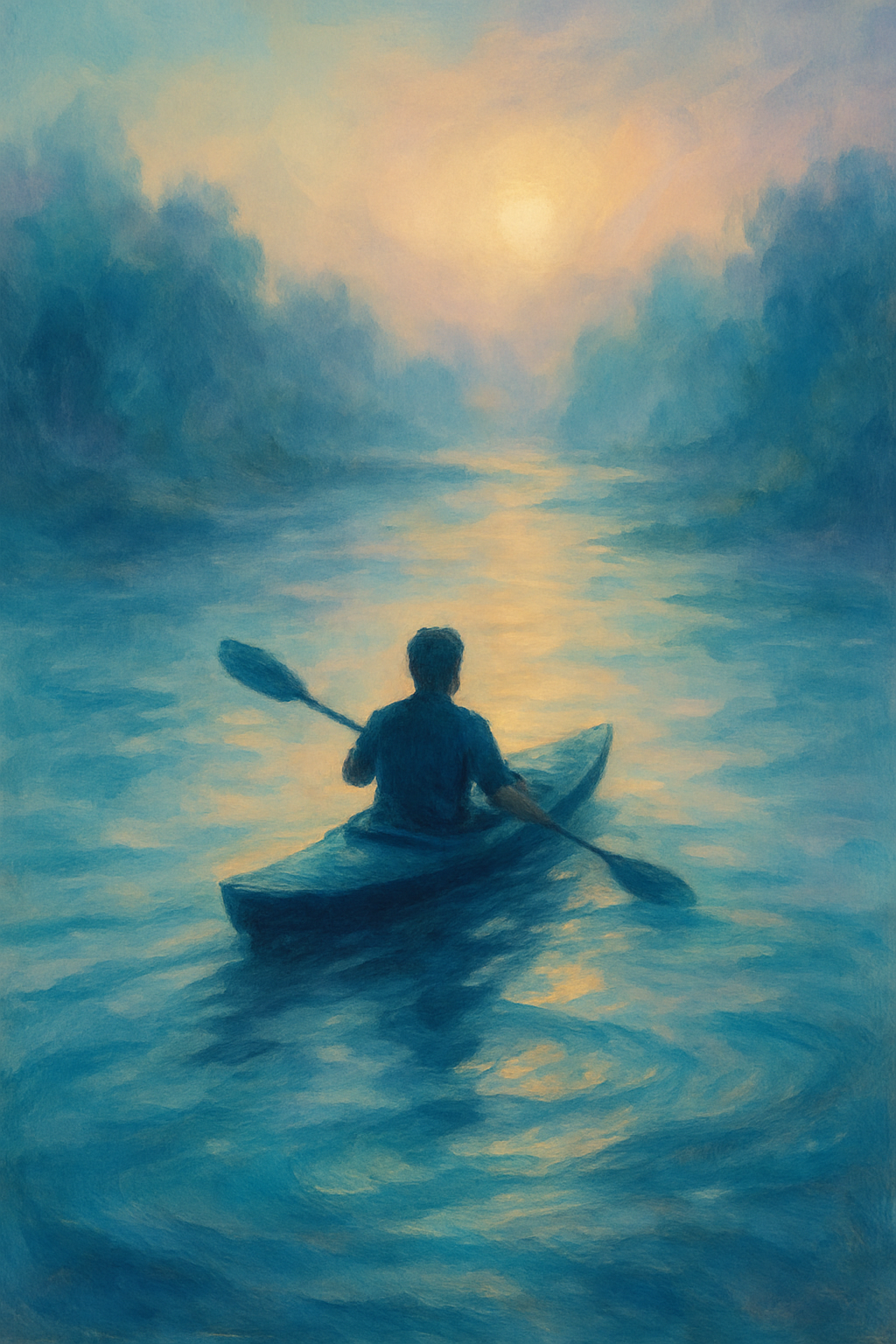
When I get into the zone, my mind is quite still. I'm not thinking much in the way of conscious thoughts. Yes, I do have some thought processes, but they tend to come more as part of the flow than from my own efforts. I like the term "flow" because I think it very accurately describes the zone. I think of consciousness as a river and myself as a kayak flowing in its current. This is how I view flow state. It's as if the ideas and thoughts are just flowing all around me, and I simply allow myself to be caught up in their current. I'm aware of them, but I'm not trying to alter them. I don't try to change the current or force certain thoughts or ideas to come. I just allow what's there to be as it is. I go where they take me.
The funny thing about being in flow state is that it feels effortless. To someone listening from the outside, my performing may seem full of effort and work. There is a certain amount of mental energy that goes into performing in flow state to be sure. But it's not near as much as most people think. To use another car example, it's like driving a car in overdrive. If you were to attempt to drive your car on the highway in 3rd gear, you'd use an enormous amount of gas, not to mention the extra wear and tear on the engine parts. But when you put the car in overdrive, the gear ratios make it so that your car consumes less fuel at those speeds. Your car still uses gas, but not near as much as it would if you drove in 3rd gear. This is how it is with the zone. I am still using energy, and I'm still thinking, but I'm doing so in overdrive.
Now that I've described the mechanics of flow state, the question becomes: Who exactly is doing the playing when I'm in that state?
Who is the "Me" That Plays or Composes Music?
This is probably going to sound a bit esoteric, but it's the way I perceive this process of playing in the zone. I feel like it's not just me playing when I play in the zone. It feels as if I become a channel, and part of what is going on is that I am channeling the music from someone else in another place.
Truly, I don't know where the music comes from. I don't exactly know how I do what I do. I have practiced countless hours over the last 40+ years, and my skillset has reached a point in which I can perform at a very high level. But is it really "me" that is performing? I'm not so sure it is, at least not completely me. And this brings me to my final point.
God and Flow State
First, I have to start this section by telling you that my definition of "God" might be different than your definition of God. If you want to better understand my view of God, visit my overview post about my spiritual journey.This will give you some idea of where I'm coming from. And if you really want details, you can read the entire series.
I believe God—or the Profound as I call it—is very much a part of music. When I say that I'm channeling when I perform, it's the Profound in me that I channel. Is this Profound a separate entity that exists apart from me? I don't think so. Is it the same God that is portrayed in the Judeo-Christian sacred texts? Unknown. All I know is that I have this Profound deep inside me, and it is my solid rock. It's indescribable. It's completely ineffable. And it's undeniable. If you are looking for the same thing in you, I can't tell you how to recognize it in yourself. I just know that once you experience that part of you, you will have no doubt.
For me, the Profound is the music. Asking whether God is part of music is like asking whether hydrogen is part of water. Without God, there is no music.
Conclusion
In summary, for me flow state (or the zone) is a condition brought about by the combination of refined skills, a relaxed mind, and pure joy. When I'm in flow, my mind really isn't thinking much. It's more of a situation in which I am deeply attuned to something that I consider to be beyond this world. Though my fingers and hands play the music, it often seems to me that they are being directed by a source beyond me. When I want to get into this state, I focus on the Profound that I know to be so deep within me. This is a presence that I have known for nearly my entire life—even in the years I considered myself agnostic. I find that focusing on the Profound tends to put me in the zone rather quickly.
So, how can you find the zone? How can you achieve flow state in your own life? I'm willing to bet you probably already have in some area or some discipline of your life. If you already have a particular skill that is advanced—whether that's plumbing, mechanical skills, art, athleticism, math, whatever—try to get yourself quiet for a bit. If you've never meditated, just try sitting comfortably and closing your eyes for 60 seconds. In that 60 seconds, just allow your mind to go. The thoughts will likely come. Just let them flow by. Don't grab on to any of them. Your mind may start to remind you of things you'd forgotten you need to do. Or your mind might try to bring up past pain or difficulties you've experienced. That's OK. Briefly acknowledge them and then let them go. Once you still your mind, try activating your skills. Start with some low-risk task, something that doesn't matter if you mess it up. Allow yourself to perform the task from your deep intuition while staying in that still mindset.
When we ask, "Where does music come from?" the answer is likely deeper and more profound than most people think. One crucial piece of the answer lies in flow state. When you get to where you can still your mind and activate your skills together, flow state is not far behind!